
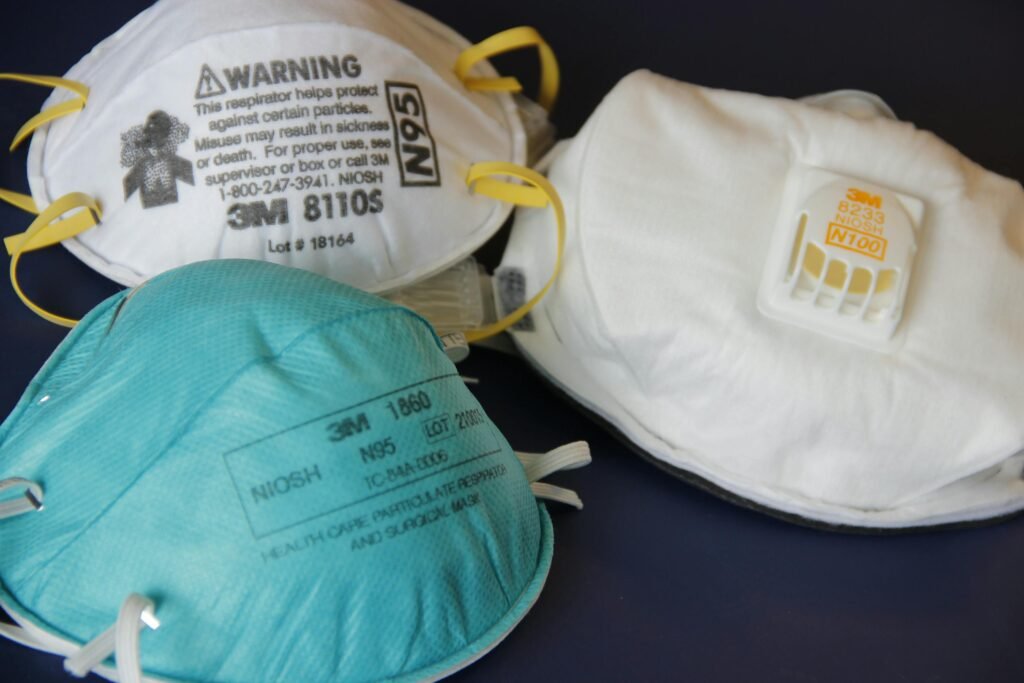
N95, P100 and the Science of the Seal
When the AQI in an Indian metro hits 400+, the air becomes a personal health hazard. While we’ve discussed cleaning the air in your home, you still have to step outside. As an Anesthesiologist, I deal with “face masks” daily. The most expensive filter in the world is useless if the air leaks around the edges.
1. The Assessment: N95 vs. The Rest
In India, the market is flooded with “pollution masks” that are often high on fashion but low on filtration.
- The Cloth/Surgical Myth: These are designed to protect others from your droplets. They offer nearly 0% protection against PM2.5 because the gaps in the fabric are like “throwing a pebble through a chain-link fence.”
- N95/KN95/FFP2: These filter 95% of non-oily particles. The “N” stands for “Not resistant to oil.”
- P100 (The “Pink” Filters): These are “Oil Proof” and filter 99.97% of particles. In a severe industrial leak or extreme smog, these are the gold standard.
The Doctor’s Corner: The Physiology of “Dead Space”
In anesthesia, we are obsessed with Dead Space—the volume of air that is inhaled but does not take part in gas exchange.
1. The Work of Breathing (WOB)
When you wear a high-filtration respirator (like a P100), you increase the resistance to air inflow. For a healthy person, this is a minor inconvenience. However, for an elder with borderline heart failure or a child with asthma, this increased WOB can lead to:
- Inspiratory Muscle Fatigue: The diaphragm has to work harder to pull air through the filter.
- CO2 Re-breathing: If a mask is poorly designed, you may re-inhale too much of your exhaled CO2, leading to headaches and dizziness.
2. The “Seal” is Everything
As a doctor, I know that if a mask doesn’t fit the bridge of your nose or your chin perfectly, you are breathing unfiltered air through the path of least resistance (the leaks). A 10% leak in an N95 mask reduces its effective filtration by nearly 60%.
Management: The “Home Fit-Test” & Maintenance
- The Beard Factor: In India, many men have facial hair. An N95 will not seal over a beard. For the mask to work, you must be clean-shaven where the gasket touches the skin.
- The “Sugar/Salt” Test: How do you know your mask fits? Put it on, then have someone spray a strong-smelling substance (like a concentrated perfume or even a sweet aerosol) near you. If you smell it instantly, your seal is broken.
- Rotation Strategy: In our humid climate, N95s get damp from breath. This degrades the electrostatic charge that traps particles. Use the “5-Day Rotation”: Have 5 masks labeled Monday–Friday. Use one, then let it dry for 4 days. This extends the life of the mask and kills most surface pathogens.
Actionable Tips: Do This Today
- Check for the “Headband”: Avoid masks that only have ear loops if you are in “Severe” AQI zones. Ear loops don’t provide enough tension for a medical seal. Look for masks with behind-the-head straps.
- The “Glasses” Test: If your glasses fog up while wearing a mask, your seal is leaking at the nose bridge. Adjust the metal clip until the fogging stops.
- Stock “Valved” for Smog, “Unvalved” for Sickness: Masks with valves make it easier to exhale (lowering WOB), which is great for pollution. However, if you are sick, the valve lets your germs out. Stock both.
- The Commuter Kit: Keep two N95s in your car or laptop bag. Indian air quality can shift from “Moderate” to “Hazardous” within a few kilometers depending on traffic and construction.