
In the “Rule of Threes,” you can survive 3 weeks without food and 3 days without water, but only 3 minutes without air. As an anesthesiologist, my entire profession is built on the “Airway First” principle. If the atmosphere is compromised, every other preparation—no matter how expensive—becomes irrelevant.
For the Indian household in 2026, “Air Prepping” isn’t just about gas masks; it is about managing the unseen clinical threats of urban living.
1. The Three Invisible Enemies
- PM2.5 (Particulate Matter): Fine external pollutants from traffic and construction that enter the bloodstream and cause systemic inflammation.
- CO2 (Carbon Dioxide): The internal threat that builds up in sealed or “hardened” rooms, leading to cognitive dulling and “air hunger.”
- VOCs (Volatile Organic Compounds): Chemical off-gassing from paints, cleaning agents, and plastics that accumulate when ventilation is restricted for security.
The CO2 Paradox
The more you “harden” your home for security (sealing windows, reinforced doors), the faster you create a Hypercapnic Environment. In a sealed 10×10 safe room, two adults can hit 2,000 ppm of CO2 in just a few hours. This leads to poor decision-making exactly when you need your mind to be sharpest.
2. Monitoring: Know Your Numbers
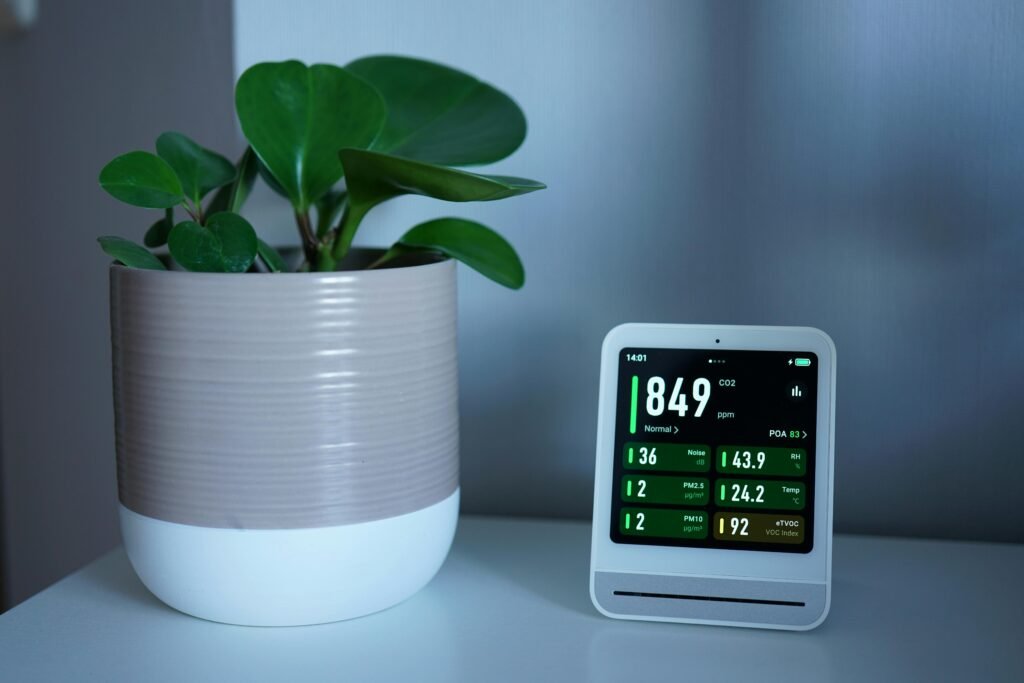
You cannot manage what you do not measure. In the hospital, we use capnography; at home, you need an Air Quality Monitor.
2026 Standard: Look for devices like the Airveda or Temtop M10. They monitor PM2.5 and AQI effectively for around 10,000 INR.
3. Filtration: Beyond the “Air Purifier”
Most store-bought purifiers are designed for comfort, not survival. For a resilient home, you need to understand the Micron Gap.
- HEPA (H13/H14): The baseline. It catches 99.97% of particles at 0.3μm. This is sufficient for PM2.5 and most bacteria.
- Activated Carbon: Mandatory for VOCs and odors. Ensure your filter has a thick bed of actual carbon pellets, not just a “carbon-coated” cloth.
- ULPA (Optional): Used in cleanrooms. It catches 99.999% of particles down to 0.1μm. While superior, it requires much stronger fans and uses more power.
4. Ventilation: The “Positive Pressure” Strategy
The ultimate goal for a Resilient Home is Positive Pressure Ventilation (PPV).
By forcing filtered air into the room, you create a higher pressure inside than outside. This ensures that any “leaks” in your doors or windows blow air out, preventing unfiltered smoke, dust, or contaminants from seeping in.
- DIY Implementation: A high-static pressure fan connected to a HEPA intake duct.
- Professional Implementation: Wall-mounted Positive Pressure Modules (common in Indian labs and hospitals) can be integrated into your home design for 30,000–50,000 INR.
Actionable 2026 Air Checklist
- Seal the Gaps: Use weather-stripping on your “Safe Room” door. It’s the first step in controlling your atmosphere.
- The CO2 Rule: If your monitor hits 1,000 ppm, your brain performance is dropping. At 2,000 ppm, you are clinically “foggy.” Open a source of fresh air immediately.
- Redundant Power: Ensure your air filtration is linked to your battery backup. In a crisis, the “Grid” is the first thing to go, but the need for air remains constant.
Medical & Financial Disclosure: This content is for educational purposes. We are independent and do not receive commissions from mentioned links. [Read our full disclaimer here].